Showing posts with label Mezze. Show all posts

Wednesday, July 17, 2013

Afghani dumplings and a ring from Kabul


'Ashak' - Afghani dumplings


I was thinking recently what a coincidence it is that three of the world’s most alluring cuisines ... food from Iraq, Syria and Afghanistan ... are from countries currently steeped in seemingly endless conflict.   Aside from the appalling loss of human life, family upheavals and the damage to those countries’ cultural heritage (like the destruction of the Buddhas of Bamiyan by the Taliban in Afghanistan and the more recent bombing by Assad’s forces of Aleppo’s medieval market - a UNESCO World Heritage Site - in Syria), the ongoing insurgencies in these countries have overshadowed the rich heritage of their cuisines developed over centuries.

Regretably I have never had the opportunity to visit these countries; but the closest I have come to experiencing Afghani culture in recent times was stumbling across a tiny shop in an outer suburb of Paris that sold Afghani artefacts, clothing and jewellery.  Aside from incredibly beautiful – and expensive – Pashmina shawls and an impressive collection of Pakols – Afghani woollen hats, the shop had an array of traditional Pashtun jewellery, including this beautiful ring which I bought for Juhee.   The Afghani shop owner told me it was made in Kabul from an old silver coin with the text written in Farsi.
 
Juhee's ring from Afghanistan

My interest in Afghani food was piqued the other evening when I was watching an episode of “Food Safari” on Indian TV; this show is fronted by a former colleague from SBS News, Maeve O’Mara.   Anyway, she was watching an Afghani-Australian woman cooking in her kitchen (in Sydney, I think) and the several dishes she made looked and sounded both unique and delicious.   This inspired me to indulge yet again in one of my only vices here in Hyderabad: buying cookbooks on the ‘net.   And sure enough, Flipkart (India’s Amazon) had a book entitled “Afghan Food & Cookery” by Helen Saberi.

 After doing a background check on this book – including discovering that the author was a researcher and contributor to Alan Davidson’s monumental “The Oxford Companion to Food”- I ordered the book on-line.  
 
Its an impressive volume with chapters on various Afghani breads, street food, Asian-style pasta and noodles, kebabs, rice pilaus, qormas (Afghani stews) and unusual desserts.  The recipes are designed within a distinctly Afghani tradition but combined with a Western sensibility to sourcing ingredients and health conscious alternatives.

One of the recipes demonstrated on the “Food Safari” episode was 'Ashak' ... hand made dumplings stuffed with a leek and chilli filling and served over yogurt sauce with dried mint and an Afghani lamb ‘keema’ or mince curry on the side.

 
Here is my version of this dish which we ate last night; the kids really enjoyed the dumplings.  The recipe is courtesy of “Afghan Food & Cookery” ... maybe it’s Iraqi and Syrian dishes next time? 

'Ashak' served on a platter with the yogurt, mint  & keema dressing
 Recipe:     “Ashak” ... Leek filled Dumplings with Meat Sauce  
                                               From ‘Afghan Food & Cookery’

 Ingredients:

3 ½ cups of plain flour   4 t salt   1 egg   2T veg oil   ½ kilo washed & finely chopped leeks (I used 3 leeks)   ½ t chilli pepper   1 ½ cups of yogurt   3 cloves of garlic, peeled and chopped finely   1 t vinegar   1 T dried mint

For the meat sauce:   6 T veg oil   2 red onions, finely chopped   ½ kilo lamb mince   ½ cup tomato paste   salt & pepper

 Method:

 Prepare dough:   sift flour and 1 t salt into bowl, make well in centre and whisk in egg and 1 T oil.   Add ½ cup water slowly and knead thoroughly to form a smooth dough.  (I added 2 T extra water.)  Divide into 2 balls & cover with damp cloth for an hour.

The dough rolled into a ball to rest before rolling

Prepare meat sauce:   Heat oil in pan, add onions and fry until reddish brown, stirring every now and again.   Add meat and stir fry until brown.   Add tomato paste, bring to boil and then add salt & pepper.   Lower heat and simmer until sauce is thick.   (I used less oil and added cumin, turmeric and chilli powder to give it a bit more flavour.)

Mix chopped leeks with salt and chilli powder and drain in colander the mix in T of oil.

The chopped leeks marinated with salt, chilli & oil

Roll out one ball of dough onto lightly floured surface to a thickness of 1/16 “ ... avoid thicker pastry as it will make dumplings tough.   Cut out rounds about 2 ½ “.  Place teaspoon of chopped leeks in each round, fold over one half and seal dumplings by squeezing  or pleating edges.   Place on well floured tray & avoid overlapping as they will stick.  Cover with cloth until ready to cook.   Repeat with remaining ball of dough.
 
The dough rolled out to a thickness of 1/16th"


Filling the dumpling skins with the leeks


The dumplings ready to be boiled
Place yogurt in bowl and mix in garlic & 1 t salt.    Spread half mixture on serving platter or individual plates.

Yogurt beaten with salt, garlic & chopped green chilli
Boil 7 cups of water and add 1 t salt and vinegar.   Put ashok into water and boil gently about 10 minutes.   Remove & drain on mesh.    Place dumplings on plate with yogurt dressing, cover with remaining yogurt, sprinkle on dried mint and a little of the minced meat.

Serve with rest of meat in a separate bowl.


Tony saab, Hyderabad July 2013


Thursday, October 11, 2012

"Jerusalem": is this the cookbook of the year?


The cookbook - just released in the UK

Anyone who follows the international food media – newspapers, magazines and blogs – would have read of the much anticipated “Jerusalem”, the third cookbook by Yotam Ottolenghi and Sami Tamimi that was published in the UK last month and is about to be released in the US.   Fortunately, I was able to get a copy here in Hyderabad last week via the miracles of on-line retailing ... and it’s extraordinary!

The original "Ottolenghis" in Notting HIll, London

Ottolenghi and Tamimi are the co-proprietors of the string of Ottolenghi restaurants and delicatessens  in central London.   They are also a publicist’s dream couple .... one an Israeli brought up in the Jewish west of Jerusalem  and the other a Palestinian brought up in the Arab east side of the ancient city ... never meeting each other until 20 years later when they formed a culinary and business partnership in London.

Sammi Tamini and Yotam Ottolenghi

Yotam Ottolenghi has the higher profile of the two.  A former journalist and academic with a Masters degree in Comparative Literature, he changed careers when he moved to London and went on to become a successful chef, cookery writer and restaurateur.  He has a highly popular weekly column in The Guardian newspaper and does most of the media for the businesses.     Sami Tamini began working as a chef in Jerusalem and Tel Aviv before moving to London where he is now head chef of the Ottolenghi empire.

Their first book – the eponymously named “Ottolenghi”- is on the UK Amazon’s “ten best cookbooks of all time” list, and their second book “Plenty” - a modern day bible of Middle Eastern-influenced vegetarian cooking - this year received a second life when it was released to wide acclaim on the American market.   (I just hate these guys!)

The Muslim quarter of Jerusalem

“Jerusalem” is both a homage to their childhood memories of food and the relatives and friends that cooked for them and also an attempt to reflect the extraordinarily rich multicultural fabric of the city.  

“Consider this: there are Greek orthodox monks in this city; Russian Orthodox priests; Hasidic Jews originating from Poland; non-Orthodox Jews from Tunisia, from Libya, from France or from Britain; there are Sephardic Jews who have been here for generations; there are Palestinian Muslims from the West Bank ... ; there are secular Ashkenazi Jews from Romania, Germany and Lithuania and more recently arrived Sephardim from Morocco, Iraq, Iran or Turkey; there are Christian Arabs and Armenian Orthodox; there are Yemeni Jews and Ethiopian Jews but there are also Ethiopian Copts; there are Jews from Argentina and others from southern India; there are Russian nuns looking after monasteries  and a whole neighbourhood of Jews from Bukhara (Uzebekistan).”
 
From the introduction to “Jerusalem” 

One of the key recipes in the book is hummus, which is included with a number of mouth watering variations.   The authors write of the “hummusia fetish” in Jerusalem with many of the ethnic groups above claiming ‘source of origin’ for this chickpea-based dish: “Generally most people agree that it was Levantine or Egyptian Arabs who first made hummus, though even this is debatable!”

I have been struggling on and off to make hummus for the past 25 years ... and IT’S NEVER WORKED!   From my early cooking days as a half-baked vegetarian student at Monash University in Melbourne, I have attempted this recipe every now and then and it has always come out as glug!   It didn’t help either that this dish became a bit of a cliché in restaurants in Australia as we began to embrace Middle Eastern and Lebanese cuisine in the 1980s and 90s.  At the end of a party there would be these plates of dried out, crusted hummus sitting next to the overflowing ashtrays and spilt plastic glasses of cheap red wine .... uuggh!

So I was surprised the other evening when I made the basic recipe that it turned out so perfectly.    Maybe it was my home-made tahini paste that was lighter than the store bought stuff ... or maybe it was adding iced water rather than more olive oil to the blender that did the trick?
 
Hummus Kawarma is basically hummus topped with pan grilled lamb

The add-on recipe that I cooked was “Hummus Kawarma” or Lamb with Lemon Sauce, which highlights finely chopped lamb pieces pan fried in ghee and olive oil served on top of a pool of hummus scattered with whole chickpeas and topped with a puckery lemon sauce consisting of finely chopped parsley, lemon juice, green chillies and white wine vinegar.

The Fattoush salad

It was fantastic!   We ate this with a bread and crisp vegetable salad  (“Na’ama’s Fattoush”, also from the book) which involves marinating the ingredients in a home-style buttermilk made by ‘fermenting’ full cream milk and thick yogurt for several hours; the milk we get over here of course is from buffaloes and this only added to the creamy texture of the final dish.

I’ve only just started dipping into “Jerusalem” but the recipe titles give some indication of the style and substance of the book ... “Roasted sweet potatoes & fresh figs”, “Lemony leek meatballs”, “Braised quail with apricots, currants & tamarind”, “Saffron chicken & herb salad” and “Set yogurt pudding with poached peaches”.   So far “Jerusalem” is looking like my favourite cookbook of the year!

Here’s the first recipe ....

“Hummus Kawarma” or Lamb with Lemon Sauce

first the basic hummus ...

Ingredients:     250g chickpeas    1 T bicarbonate of soda    250g of tahini paste (I used less)    4 T lemon juice    4 garlic cloves, crushed    100ml of iced water (I ended up using about 200+ml of water to lighten the chickpea paste after grinding)

Method:   Wash chickpeas and soak in twice their volume of water in a pot overnight, stirring in the bicarb’ soda which helps soften the peas.  Next day cook chickpeas in saucepan with 1.5 litres of water (for 20 to 40 minutes) until soft and tender.   I use a pressure cooker to quicken this step ... and save gas from our bottle in the kitchen!

Drain and cool the chickpeas and place in large blender/mixer.    Process until you get a smooth paste and then add tahini paste, lemon juice, garlic and 1 ½ t salt.   Then you slowly add the iced water until you get a smooth, creamy texture.  (I just added all the ingredients pretty much from the start as the chickpeas wouldn’t break down on their own in my mixer;  I found I had to add twice the amount of iced water to achieve the proper texture.)

Leave aside covered for at least 30 mins.

Hummus Kawarma

Ingredients:    (1)   the basic hummus recipe, as made above plus small cup of extra cooked chickpeas for garnish    3 T toasted pinenuts to garnish

(2)  300gm fillet of lamb, finely chopped by hand (I used about 500gm for 4 people)   ½ t pepper   ½ t ground allspice    ½ t cinnamon    pinch ground nutmeg    1 t zaatar spice mix or oregano    1 T white vinegar    I t chopped mint    1 T chopped parsley    1t salt    1 t olive oil

Lemon Sauce Ingredients:    10gms flat leaf parsley, finely chopped    1 or 2 green chillis, finely chopped    4 T lemon juice    2 T white wine vinegar    2 garlic cloves, crushed    ¼ t salt

Method:    Place all the kawarma ingredients (no 2) - apart from olive oil - in a bowl and mix thoroughly, marinate 30 mins+  in fridge.

Just before cooking meat, mix all ingredients for lemon sauce together in a bowl.

Heat olive oil in pan to medium high and cook meat in batches.   Recipe says meat should be slightly pink (cooked only 2 to 3 mins) but here in India I cook meat a little longer just to be safe!

Divide hummus between 4 to 6 bowls or plates and spread out, leaving a slight indentation in the middle.   Spoon the warm kawarma into the middle of plate and scatter with the extra chickpeas.   Drizzle over the lemon sauce and scatter extra parsley and chopped nuts over top.   (I also drizzled some xv olive oil around edge of plate.)

Serve ... and raise a toast to hopes for peace in the Middle East!
  
P.S.   which I guess translates in the near future to at the very least: Obama IN – Netanyahu OUT!


Tony saab/Hyderabad/INDIA    Oct 2012    


Wednesday, July 4, 2012

My love affair with Japanese food ...

Tokyo skyline at night


I have had an interest in Japanese culture - and especially it’s food – ever since I can remember.   Growing up, my father – who had fought against the Japanese during the Second World War – kept a number of mementos from that time hidden in various parts of our house. In a wardrobe I stumbled upon a silk Japanese flag which he had taken from a POW and, of even greater significance, was a ‘Samurai’ sword that I later discovered hidden under the house.   As a 10 year-old these things had a magical fascination for me.

The Imperial Palace in the heart of Tokyo

At university we studied Japanese cinema and, as my interest in Asian food and cooking broadened, with backpacking trips to Asia in the 1970s, I began to more seriously investigate the cuisine of the Rising Sun!   This was also a time when Japanese food ingredients were becoming available in Australia ... initially driven I remember by the 1970’s interest in ‘health foods’ and macrobiotics.

Then in the 1990’s I was fortunate to go on two work-related trips to Japan – sponsored by the Japanese Foreign Ministry – and here my interest in Japanese cuisine really blossomed.   Whilst I was filming for an Australian television network during the day, we spent the evenings exploring the bars and small outside food carts of Tokyo. 

A typical Japanese bar ... lots of atmosphere!

Most of these bars were tiny establishments by Western standards – often one or two floors underground in the basements of commercial buildings.   Smoke filled rooms, with dark lighting and Miles Davis on the sound system! But they all served an amazing array of tapas-like snacks – dumplings, sushi, sashimi, and a wild array of grilled seafood, meat and offal.

My faded menu from the 400 year-old Junsei Restaurant
in Kyoto

In Kyoto, the country's ancient capital, we ate at Junsei - a 400 year-old restaurant that only specialised in soy beancurd - or tofu.   It was served in beautiful ceramic pots floating in an intensely flavoured fish stock; the tofu just melted in your mouth and the meal was one of the most memorable I have had so far!

 Another of the meals we ate on one of those trips was at a country inn in the mountains outside of Tokyo.   This wooden hotel was so old that the ceilings were only about five feet high - with the beams covered in rubber foam to protect your head! - because 400 hundred years ago the Japanese were much shorter than they are today mainly due to their diet at the time!

One of the attractions of Japanese cuisine for me is the often utter simplicity of the recipes – using basic ingredients usually of high quality and cooked in very precise and delicate ways. The dinner we were served in this little hotel - surrounded by giant pine trees, mossy covered rocks and a stream that ran right past the windows - was Zen-like in its simplicity.   Grilled fish - caught from the stream outside - lightly garnished with rock salt and soy/shoyu sauce, steamed green vegetables with pickled ginger, miso soup with slivers of wild mushrooms and tiny blocks of tofu, and chicken yakitori - tiny satay- size sticks of smoked chicken grilled over hot coals.   Again this was one of the most memorable meals of my life.

I have tried since then to recreate some of these dishes and, more importantly perhaps, some of the atmosphere of those meals in my own cooking.   One of the lessons I learned from Japan was the concept of 'less is more'!   You don't need mounds of food and rich sauces to make an interesting and satisfying meal.   

One of my all time favourite cookbooks!

During my Japanese culinary journey I discovered a wonderful little book that replicated many of the dishes I had eaten in Tokyo and Kyoto: The Japanese Country Cookbook by Russ Rudzinski & Ryoichi  Kokku (Nitty Gritty Books, 1969).  My first copy of this book fell apart from overuse and I had it rebound in Melbourne; however, the printer stiched it back together 'back to front' so you had to open it from the back cover.   (Strangely, this is the way Japanese books written in Kanji are also printed!)     So I finally tracked down another copy in an on-line second hand bookshop and this is the copy I have with me in India

Here are a few of these country-style Japanese recipes that I have been cooking time and again over the past 15 odd years ... each an exercise in elegant simplicity!

Brussel Sprouts Hot or Cold

Ingredients:
½ kg brussel sprouts   2T shoyu (Japanese soy sauce)   2T dry mustard powder   2T water   2T sugar    1 T sake or white wine ... or vodka in India!?

Method:
Cut sprouts in half – leaving on part of the root/base to keep them together –and steam or boil 3 to 4 minutes.   Mix all other ingredients together and pour over drained sprouts – let marinate for at east 1 hour at room temperature.   Can be served cold or reheated.


Kara Pima  (Hot bell peppers or capsicum)

Ingredients:
4 capsicum – preferably red or yellow  2 fresh chillies   2T veg oil    1t shoyu    1t rice vinegar

Method:
Cut capsicums into bite size pieces, removing stems, seeds and white pith.   Mince chilli.   Heat oil till hot and add capsicum, toss for 2 minutes then add chilli & toss for 2 minutes then add shoyu & vinegar, cover the pan and cook a further 2 to 5 minutes.   Serve hot or cold.

Both these dishes can be served as part of a meal from many different cultures ... not just Japanese.

Tony saab/Hyderabad   July 2012


Tuesday, May 29, 2012

Mango Mania in India

MANGO MANIA
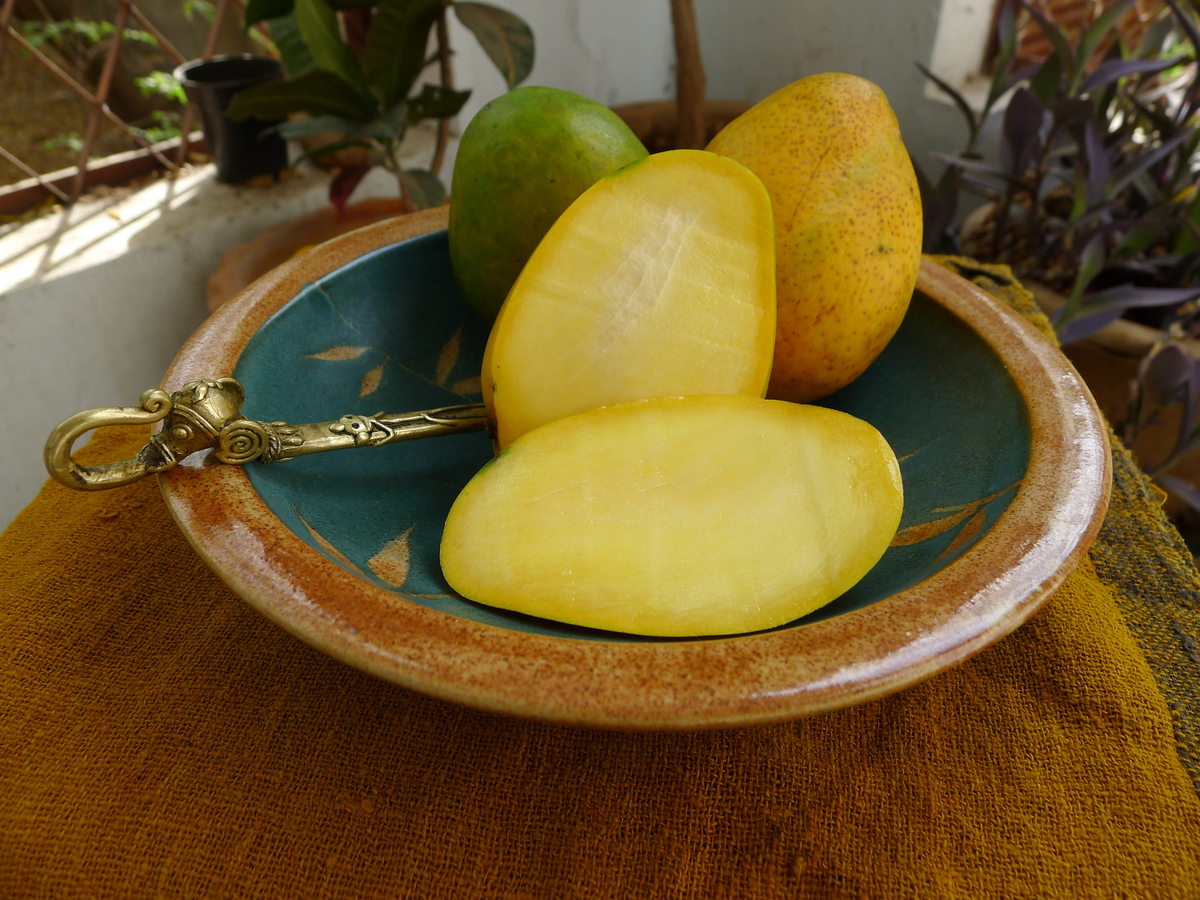
Mangoes in Hyderabad May 2012

The mango season has well and truly arrived again here in Hyderabad - and indeed across India - and, despite dire predictions of a shortage of crop due to rain damage earlier in the year, the markets are brimming with mangoes of all shapes and sizes ... Alphonsos, Banganpallis, Malgovas, Dussehris and Raspuris to name just  a few varieties of what is known as the "king of fruits".


There are some 500 commercial varieties of mangoes around the world and India is the largest producer ... growing more than 11 million tonnes of mangoes annually and supplying more than 50% of the world crop.   The state of Andhra Pradesh - of which Hyderabad is the capital - is one of the centres of mango production in India ... producing the highest yield per acre in the country.

Mangoes in India are used in a myriad of different recipes - in curries and pulaos, chutneys and pickles, combined with seafood, chicken and other meats, in cakes and traditional Indian desserts, mixed into cocktails and other non-alcoholic drinks.   Some are cooked when they are still green and unripe and some are used when they have developed that familiar golden hue.


Health freaks will rave on about how the fruit is high in Vitamin C and beta-carotene but the main attraction of the mango is just the spectular burst of flavour that you get when eating them!

Here are a few of my favourite recipes that I have been cooking over the past few weeks:
Stephanie Alexander's Mango Salsa

The cook, writer and restaurateur Stephanie Alexander is regarded as something of a national treasure in Australia and her most well known book, "The Cook's Companion" - a 1200 page scholarly compendium of ingredients and recipes for the Australian kitchen - has been in print for the past 20 odd years and regularly rates as the one of the best cookbooks in Australia.

I was lucky enough to meet her in her house in Melbourne some years ago when I was filming a profile on Kylie Kwong, the Chinese Australian chef now made famous across Asia through her cooking shows on cable television.   Stephanie has been a mentor to Kylie throughout her career and has influenced many other younger generation chefs over the years.

Here is her wonderfully tasting Mango Salsa recipe thats simply bursting with flavours ... it goes with just about any main course meal ... especially chicken and seafood dishes.

Ingredients:
1 mango, peeled and diced    5 slices of red onion or 2 shallots, minced    1 red or green chilli, finely chopped    1/4 C fresh mint leaves, chopped    2 T lime juice    1 t sugar   
Method:
Combine all ingredients in a small bowl and allow to stand in fridge  for severalhours before using.   Great with seafood or poultry. 

Desert Candy's Mango Salad


This simple recipe comes from one of my favourite food blogs - Desert Candy - written by Mercedes,  a young woman based in the US with a Middle East/Arab background.  Her blog explores recipes and stories from across the Middle East and more Western repertoires.

Ingredients:
Diced fresh mango, unsweetened dried coconut, chopped scallions (green parts only), toasted cashews or peanuts, lime juice, salt.

Method:
Simply mix together all ingredients in proportions suitable to your liking.

Seriously tasty and great alongside grilled chicken or anything spicy.


Shelina Permalloo's Mango, Rum and Lime Syllabub


I read a profile on Shelina Permallo (in The UK Telegraph newspaper ?) after she won the most recent UK Master chef series; she is an amateur British cook with a Mauritian-heritage which she apparently incorporated into her winning recipes on the television series.   Mangoes are said to be a recurrent theme in her cooking and this dessert was a winner from the first time I made it for a dinner party.   (see A Spanish Meal)
Ingredients:
300ml double cream    150ml Alfonso mango purée    2 Alfonso mangoes chopped into 1cm cubes    75ml of rum, plus 4 tsp    4 limes (juice and grated zest)    Seeds scraped from ½ a vanilla pod   (or use teaspoon vanilla essence)    3 tbs icing sugar    4 ginger biscuits, crushed    Desiccated coconut to sprinkle over the top
 Method:
1/.   Put the biscuits in a plastic bag and use a rolling pin to smash them into crumbs.
2/.   Lightly whip the double cream and add the vanilla, 75ml rum, lime juice and zest. Keep whisking until it forms light peaks.
3/.   Add 50ml of the mango purée and fold through for a marbled effect.   Chill again if time.
4/.    To assemble, divide the crumbs between four glasses. Sprinkle 1 tsp of rum over each and pour over the mango purée.
5/.    Add mango cubes & mint & coconut.

Have a great mango season wherever you are!

Tony saab/Hyderabad   May 2012