Saturday, September 22, 2012

Lord Ganesha & the Italian Grandmother's Semolina Cake

Lord Ganesha in the waters off Chowpatty Beach, Bombay
Last Wednesday here in Hyderabad we celebrated the birthday of Lord Ganesha, the Hindu elephant god worshipped across India as the god of wisdom, prosperity and good fortune.   It’s a public holiday in many parts of the country and, like most religious festivals across the subcontinent,  everybody joins in to some extent – Hindus, Muslims, Buddhists, Christians ... and even atheistic foreigners!

Buying the flowers at the local market


Eco-friendly clay Ganeshas
Fresh garlands of flowers


Fruits and leaves to adorn the Ganesh statue
 We usually start the day by going to the local village to purchase a Ganesh statue and the accompanying flowers, food and banana leaves that are all part of the ritual on the first day of what is know as Ganesha Chaturthi – a 10 day festival  celebrated each year  in September which ends with the immersion of the idol in water bodies - usually lakes and seafronts around the country.


Some of these statues can be several metres high and each village or locality builds the biggest Ganesha they can afford in a sort of ethereal contest of the town’s spiritual worth.  The bigger statues have to be lowered into the water off the back of trucks with cranes especially installed for the festival.   In Bombay, where we lived for a couple of years, more than a million people crowd Chowpatty Beach to see the final immersion of the Ganesh statues.

Our ritual is a little more low key.  We always buy an eco-friendly Ganesh made of clay ... which dissolves easily in water ... unlike many of the giant plaster statues which, along with the often garish oil-based paint used to decorate them, are a major pollution problem once the festival is over.  

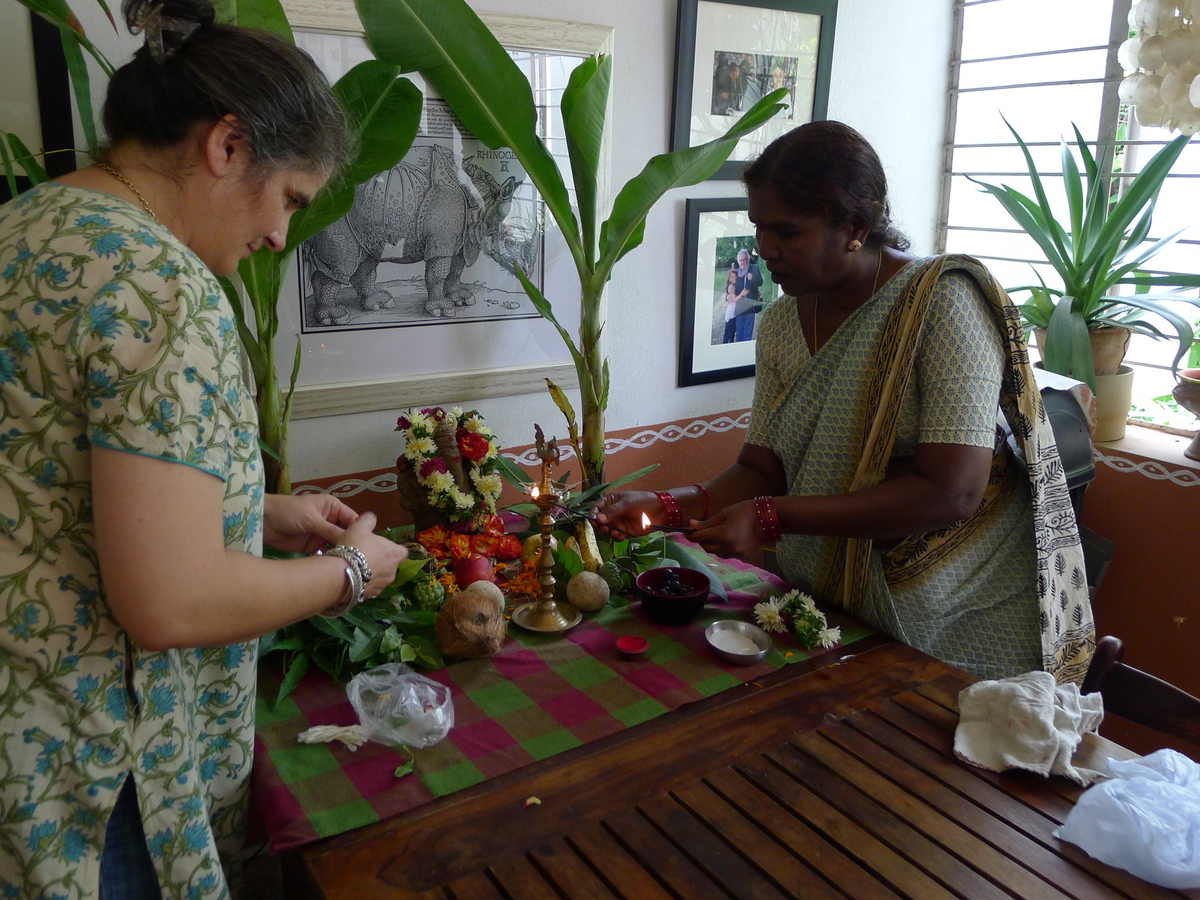
Preparing the table


Lighting the incense


Breaking the coconut


Our Ganesh statue will stay with us for 10 days
 The statue is placed on banana leaves on a table and surrounded by fresh fruit and leaves.  Then one of the ladies who works with us will recite a Hindu prayer, incense is waved over the statue and a coconut is broken in honour of Lord Ganesh.   The two halves are then placed on the table and each of us is marked on the forehead with red vermilion powder.

Happy Ganesh Chaturthi!
 This year we celebrated with a low key Indian lunch but as plans for dinner took shape I was in the mood for something different.   This is where the Italian grandmother’s semolina cake appears!


I have this fabulous baking book called  “Classic Home Desserts: A Treasury of Heirloom and Contemporary Recipes”, written by an American writer and cookbook author Richard Sax.  It’s a compendium of mostly American dessert recipes – though many are influenced by early migrant families from across Europe – and is an engaging mix of recipes, historical and anecdotal notes about cooks and quotes from literary works across 200 years of American and English history.    It was first published in 1994 and won many awards before being republished a few years ago.   (Sadly, Richard Sax died in 1995 from lung cancer at the age of 46.)

One of the standout recipes in the book is called “A Semolina Ring Cake from Friuli”; Friuli is Italy’s most north-eastern region (the Italian filmmaker Pier Paolo Pasolini was born there) and has its own distinctive food culture.   This recipe, which is over 100 years old, found its way into the book via an Italian chef’s grandmother.

My Italian semolina ring cake
I really liked this recipe upon first reading because: (1) it used Italian semolina flour, which I happened to have found surprisingly in an Indian supermarket and (2) it used unpeeled almonds!   You simply put the flour, sugar and unpeeled almonds into a blender and zap at high speed until its a fine powder.  If you have ever peeled 30 or 40 almonds as I have many times, you’ll appreciate this alternative approach!

So this is what we had at the end of dinner last Wednesday night ... an historic Italian semolina cake to celebrate Lord Ganesha’s birthday!

SEMOLINA RING CAKE FROM FRIULI

Ingredients:  
2/3  C blanched or unblanched almonds    ¾ C semolina flour  1 C sugar   grated zest of 1 lemon – 2 in India as they are too small   6 eggs, separated    pinch salt    icing sugar for topping   Plus eggnog custard with rum    (Recipe also says you can serve it with fresh strawberries but they are not in season here.)

Method:     
Preheat oven to 180C degrees .   Butter and flour a cake tin – preferably a round bundt pan.  
Grind the almonds, flour and sugar in a food processor until powdery and then add lemon zest and all of the egg yolks.  Blend and set aside.

The batter after mixing in the beaten eggwhites

Beat the egg yolks and salt in a bowl until they nearly form stiff peaks.   Fold into the semolina- almond mixture and pour into the cake tin.  Bang the tin on a surface several times to settle the batter.
Bake the cake until top is lightly golden ... about 40 minutes worked for me.   Cool cake, run knife around edge of tin, invert onto another plate or cake stand.    Top with the icing sugar & serve with custard or icecream.

Note:   suggest you find a custard recipe you are familiar with and add 1 ½ tablespoons of dark rum.   Me? ... I fucked the custard up completely by overcooking it and making it curdle ... which is why I am not showing you a picture of it ... and is also why my dear departed mother would be utterly ashamed of me!

Nevertheless, the cake was an absolute classic ... beautifully light with a lemony almond aftertaste.   If you can’t make the custard serve it with icecream ... and have a dark rum and soda instead ... that’s what I did.

Tony saab, Hyderabad Sept 2012
   

Tuesday, September 11, 2012

The World's Best Chilli Crab Recipe


Singapore Chilli Crab - in Hyderabad!
 
When I first met my partner we were living in Melbourne and both working in the media there.
She was born and grew up in India – her father was Indian and her mother Australian – so every 12 to 18 months we would plan a trip back to India to visit her father, who at the time was living here in Hyderabad.

 Often we would use this place as a base and go off exploring other parts of India or South Asia for the rest of our holidays.   However, on most of these trips we invariably stopped over in Singapore – either going or coming back – and spent either the day or an overnight stay there.  
 
Singapore - at the crossroads of South Asia
And the main reason for that was the food!   Singapore is blessed with being at the crossroads of trade and migratory movements across South Asia and beyond and as a result it has an extraordinary mix of people and cultures.

From the native Malays, early migrations of Chinese and Indians, and the arrival of the British in the 19th Century - all these cultures have left their mark on Singapore's culinary history.   And situated as it is - in a pivotal area of South Asia - other countries in the region have also heavily influenced the country's cuisine  - from the Philippines, Sri Lanka and neighbouring Indonesia to as far west as the Middle East and Saudia Arabia.

A particularly unique and singular cuisine in Singapore is known as Peranakan or Nonya cuisine.   Perankans are local Singaporese who are the descendents of early Chinese migrants who married local Malays in Singapore itself or in areas such as Penang and Malacca on the Malaysian peninsula.
Nonya cusine is a unique mix of Chinese cooking techniques like wok cooking with the spices used by local Malays and their Indonesian counterparts.   Their curries for example are often coconut based but with lashings of firey spices ... just the way we like it!

All of these different cuisines and much more can be experienced at Singapore's renowned open food markets.   Nowadays they are far more regulated - as everything else seems to be in Singapore! - but despite the somewhat "food mall" atmosphere, the actual cooking and presentation hasn't changed and you can still get extraordiary seafood dishes, satays, curries, savoury pastries , breads of all sorts and endless noodle combinations at these small, often one-owner, businesses.
Orchard Road - the place comes alive after dark ...
We would most often arrive at Singapore's Changhi Airport early in the morning from Melbourne, and then have most of the day to explore some part of the city before our flight to India that same evening.   After a quick bus ride into town we would head for the food stalls at the famous Newton Food Centre and then maybe stroll up the main shopping area along Orchard Road, or the ethnic enclaves of  Chinatown or Little India, or head off to the famous Raffles Hotel for a very atmospheric gin and tonic - or two.  

Raffles Hotel - built in 1887 & extensively renovated 100 years later

The Raffles Hotel - originally built in the 1880s - has also been "renovated" in recent years - they no longer have a  live tiger in a cage in the front bar - but it was still fun to reminisce over a drink on the balcony about the writers and other artists such as Somerset Maugham, Chaplin, Coward, Kipling and Conrad who all stayed in the very same establishment at some point in the early part of the 20th Century.  

Part of the Long Bar, Raffles Hotel
I recently read Maugham's "Collected Stories" and his writing perfectly catches the atmosphere of what these old hotels and other establishments must have been like in the dying days of colonialism in  South Asia.   However, I think you can only read Maugham in small doses as there is often an air of melancholy - sometimes sadness - hanging over his characters ... and living here in 'the tropics' it can be quite infectious ... not to be read with gin, especially!
 

Chilli crab served with rice and crispy cabbage salad
One of our favourite Singapore treats was always the chilli crab - giant mud crabs - bigger than the ones you get in Sydney and further north in Australia - cooked in a chilli and tomato based sauce.   This is the kind of dish you can only eat with your hands, cracking the shells and sucking the meat from the thinner legs as you go.

The best recipe I have used to cook Singapore Chilli Crab comes from Stephanie Alexander's book "The Cooks Companion"; at 1126 pages, this is definitely the bible of Australian cooking and was one of the cookbooks I had to bring with me to India when we moved here again.


The recipe was originally demonstrated to Stephanie by Singapore chef, cookbook writer and restaurateur Violet Oon and she cooked the dish using lobster; however, crabs are much more readily available and cheaper.   Don't be put off by the inclusion of tomato sauce as one of the ingredients; whilst it may look a bit naff' amongst the more Asian ingredients, it blends magically with the chillies, black beans and vinegar.   Besides, tomato sauce - thanks to the Maggi company - is ubiquitous across the whole of Asia these days!

Violet Oon's Chilli Crab

Wash and cut the crabs in half

Ingredients:    1.5 kg crabs in their shells   1/4C vegetable oil    8 cloves of garlic, finely chopped   8 small red chillies, finely chopped (less if you dont like it too spicy)    1 t rice vinegar or lime juice    1 egg, lightly whisked   i bunch coriander - including roots - washed & finely chopped    6 spring onions, cut into short lengths

For the sauce:    1 C water    5 T tomato sauce    1 or 2 teaspoons of Chinese black beans    1 1/2 t cornflour    1/2 t dark soy sauce (shoyu)    3 T sugar    1/2 t salt

Garlic & chilli are first cooked in oil to add fragrance

Method:

Mix all ingredients for the sauce and set aside.    Clean and cut crab into pieces, cutting the carapace in half and separate the larger legs.   (We have a fishmonger to do that for us at the front gate when he delivers!)    Heat a large wok and add oil, add garlic and stirfry 1 minute then add chilli and cook another 1 minute.    Add crab pieces & legs and cook several minutes until the shells begin to go red.  

The crab several minutes after cooking in the rich sauce
Stir sauce ingredients into wok and continue stirring for 2 minutes.   Cover and simmer over high heat for another 7 minutes, by which time all the shells will be dark red.

Remove lid, add rice vinegar and then stir in egg, mixing to form threads in the soupy stock.   Add coriander and spring onion, stir and serve immediately.

There it is ... what we think is the world's best chilli crab recipe!


Tony saab, Hyderabad India, Sept 2012


Wednesday, August 29, 2012

Apocalypse Chow

A flooded township in the Philippines - August 2012


 The recent terrible floods in the Philippines - where some 500,000 people have had to move from their homes -  reminded me of my trips to that country some 20 odd years ago.   Despite been prone to typhoons and flooding on a regular basis, the countryside is spectacularly beautiful.

 In my student days I travelled a couple of times to the Philippines – the first as part of the then de rigueur student backpackers tour of South East Asia and the second time to stay with family friends who had moved there for a World Bank posting.


The country is made up of 7000 islands

The first thing that strikes you about the country is the breathtaking beauty of the islands that make up the Philippines – some 7000 of them with a population of over 92 million people.   The people of the Philippines are generally a ‘happy go lucky’ nation – and very friendly to tourists - but I couldn’t help getting the impression that successive waves of colonialisation – by the Spanish, then the Japanese during World War 2, then the Americans in the aftermath of the war – had taken their toll on Filipino culture.   Many locals speak with a strange Spanish-American accent and all things American appear to be deified!   And much like in India, for a lot of families their ultimate dream is to migrate to the United States.

We arrived in the capital of Manila – I still remember a sign on the door of a bar: “Please leave your handguns at reception”! – but quickly left to tour the countryside; up to Baguio City, a hillstation in the mountains, and then by ferry across to the island of Cebu, a place with beautiful beaches and extraordinarily well preserved buildings from the period of the Spanish colonial occupation.   We also visited the site where the Portuguese explorer Ferdinand Magellan was killed by the native population in 1521.

The 100 Islands National Park
Just prior to touring an extraordinary area of the country known as the One Hundred Islands National Park  – full of ancient coral reefs and teeming with sea life  –  we went to see Steven Spielberg’s - at the time - new film “Jaws”.   Needless to say I didn’t venture into the water for the rest of the trip!

Apocalypse Now was shot on the island of Luzon in the Philippines

Another cinematic link with the country was Francis Ford Coppola’s epic film “Apocalypse Now”, about the Vietnam War. The film was shot in the Philippines on the main island of Luzon - from memory because the Vietnamese government wouldn’t allow Coppola’s crew to film in their own country; the war and US involvment being still fresh in everyone’s mind.   Vietnam also at this stage had not embraced Western-style development that is now proceeding at an apparently rapid pace across the country.

Marlon Brando & Martin Sheen
I took a canoe trip down the Pagsanjan River, 100 kms south of Manila, where most of the filming of “Apocalypse Now” took place.  Our boat passed the huts that were used in the opening scenes of the film where Martin Sheen’s character is lying on his bed staring at the ceiling fan.   These huts are now a tourist office.   And further down river we entered the deep ravines that were depicted in the film as the entrance to “the heart of darkness”, the area in Cambodia where Marlon Brando’s character, Colonel Kurtz was in hiding. (Who can forget Brando's lines - lifted from Joseph Conrad's book: “The horror! The horror!”)   It was a memorable experience.

But another major highlight of my two trips to the Philippines was the food!   An incredible variety of fresh seafood in the markets and 'challenging' national dishes ... like Balut!

Balut - a fertilised egg
Here is a fairly graphic description ... “A balut is a fertilized duck embryo that is boiled and eaten in the shell.  Popularly believed to be an aphrodisiac and considered a high-protein, hearty snack, balut are mostly sold by street vendors.''

"In the Philippines, balut eaters usually accompany this delicacy with salt, chili, garlic and vinegar to season their eggs. The eggs are savoured for their balance of textures and flavours; the broth surrounding the embryo is sipped from the egg before the shell is peeled, and the yolk and young chick inside can be eaten.”   Definitely an acquired taste but I ate them a number of times!


And then there were the cockfight losers!   (PETA supporters read no further.)  At some point on one of my trips we were taken to see a cockfight – a national past time that is pretty much the equivalent of horse racing in Australia in terms of popularity.   And you can also gamble on the fights.   I have to admit that – despite my sympathy for animal rights and my affection for members of the animal kingdom – I was sucked in by the atmosphere of the cockfight stadium!   Maybe it was also the San Miguel beers we were drinking throughout the night!   Anyway, without going into the gory details, at the end of the event the losers were barbecued out the back of the stadium and this chicken (or rooster?!) was some of the best bbq chicken I have ever tasted.

But for those not keen on holding a gladiatorial contest in their backyard everytime they want to have chicken for dinner, here is a somewhat more sedate but equally impressive national dish from the Philippines ... Chicken Adobo, or as I call it, Apocalypse Chow! 

This recipe is interestingly somewhat similar to India’s Goan chicken dish ... Xacuti de Galinha ... with the same emphasis on spices, garlic and the tangy taste of coconut vinegar.   (Maybe not so surprising given the Spanish/Portuguese influence in both cultures.)


Chicken Adobo

The Phillipines national dish - Chicken Adobo
'
Ingredients:

1½ C rice vinegar (or Goan coconut vinegar)     1 C coconut milk     ¼ C soy sauce     10 garlic cloves, peeled & thinly sliced     3 whole bird’s-eye chillies (or hot green Indian chillies)     3 bay leaves       1½ tsps freshly ground black pepper     2 kgs chicken pieces (preferably thighs over legs!)

Method:

Combine all of the marinade ingredients in a plastic freezer bag or large bowl  . Add the chicken and turn to coat. Refrigerate overnight or for at least 2 hours.   


The chicken pieces are marinated in coconut milk, rice vinegar,
chillies and garlic for several hours

Place chicken and marinade in a large pot and bring to a boil over high heat. Immediately reduce heat to a simmer and cook, stirring occasionally, until the chicken is cooked through and tender, around 30 minutes.

Chicken is cooked in its marinade for 30 mins
Heat grill or bbq. Transfer chicken pieces to a large bowl, raise heat under the pot to medium-high, and reduce the sauce until it achieves almost the consistency of cream, about 10 minutes. Remove bay leaves and chilies.


Chicken pieces ready to be basted then grilled
Place chicken pieces on a roasting pan and place under grill or on bbq for 5 to 7 minutes, until they begin to caramelize. Remove, turn chicken, baste with sauce and repeat, 3 to 5 minutes more. Return chicken to sauce and cook for a few minutes more, then place on a platter and drizzle heavily with sauce. Serve with white rice.


Tony saab/Hyderabad August 2012

Monday, August 13, 2012

Monsoon Madness in Goa


Monsoon winds on Anjuna Beach

My family has just spent a relaxing 4 days in Goa, on the west coast of India.   We stayed at a hotel resort outside of the northern town of Mapusa, near to the popular tourist beaches of Baga and Anjuna.   This is the off-season for tourism in Goa so the hotels, bars and street life were relatively quite ... mostly consisting of locals going about their daily business.


Mapusa's Friday Market


Goan bread

Spices are an important element in Goan cooking

Fresh vegetables in abundance ...


The area is a centre for agricultural production in the state and the Mapusa market on a Friday was teeming with local producers and sellers hawking a vast variety of fruit, vegetables, the famous Goan pork sausages and other food stuffs heavily influenced by its Portuguese heritage.

Goa was an independent Portuguese state from the early 1500s - when the Portuguese Admiral Alfonso De Albuquerque defeated the then Muslim rulers – up until the early 1960s.
During this time it was the centre of Portuguese rule in South Asia and was a major trading centre for that country’s eastern empire.

Even after India gained its independence from the British in 1947, the Portuguese refused to give up their territory and it was not until Indian troops invaded the territory in 1961 (after the then Indian Prime Minister Nehru lost patience with the European coloniser) that the province was finally returned to India.   As one writer on Goa noted, “The Portuguese thus became the first Europeans to arrive in India and the last to depart!”

Our visit to Goa was part of the Monsoon Madness Hash run – an annual event organised by various chapters of the Hash House Harriers around India.  (The Hash' is a group of runners and walkers who meet regularly for a sporting and social get together.)   There were participants from Delhi, Mumbai, Chennai and Bangalore chapters along with the Hyderabadi contingent that organised this year’s event. (Big thanks to Reggie!)


Making friends on the local bus


On the walk back from the bus to Mapusa market


Zia on stage at the Saturday night Hash party


Of course, one of the "must do's" in Goa is to try the local cuisine - which has been heavily influenced by more than 450 years of Portuguese occupation.   On the Saturday we took a trip into Panjim - the state capital of Goa - and stopped at an old Portuguese pub for lunch.   It was in a tiny street near the Mandovi River which runs through the centre of the town.


The Hotel Venite serves authentic Goan food such as Bombay Duck (despite the name, a type of small fish - crumbed and pan fried), Garlic Prawns, Fish cooked with Rechio Masala - the fiery Goan paste made with chillies, spices, tamarind and vinegar, and Shark Fillet in a Lemon Butter Sauce - very European influenced!

As well as eating at the local restaurants we also brought back to Hyderabad plenty of Goan supplies ... like the local cashew nuts (grown in abundance in Goa's climate), Goan coconut vinegar and strings of Goan pork sausages - filled with ground pork, chilli and a vinegar-flavoured spice mix

Woman selling the famous Goan pork sausages

On the way home I bought a small cookbook of Goan recipes at the airport - "Tasty Goan Morsels"; this cucumber dish has an unusual mix of flavourings and also looks simple to make at home.

Korom of Cucumber   
from   Tasty Goan Morsels    by Maria de Lourdes Bravo da Costa Rodriguez

Ingredients:    2 small cucumbers    ½ coconut, grated    1tsp mustard seeds    2 green chillies   1 tsp jaggery, or brown sugar    salt to taste

Method:    Peel cucumber and slice finely.   Salt and leave aside for 20 mins.   Roast mustard seeds until they pop, then grind with coconut and chillies.  Drain cucumber slices and dry, mix with ground spices and serve.


Another recipe we regularly use here in Hyderabad is a Goan Prawn Curry from the "Essential Goa Cookbook" - a Penguin publication which has a wonderful collection of recipes from local cookbook writer Maria Teresa, whose family came from Goa.   This book is a great introduction to Goan cooking and is readily available in bookshops in India.

Caril de Camaro - Prawn Curry   
from the Essential Goa Cookbook by Maria Teresa Menezes

Ingredients:   400gms green prawns, shelled, washed and deveined   2 ½ cups coconut milk    1 tsp corianfder poweder    2 tsp ground chillies   6 cloves garlic, finely chopped   1 red onion, sliced   2 green chillies, sliced (remove seeds if preferred)   tamarind soaked in ½ C warm water, 20 mins   salt to taste

Method:   Place all ingredients except prawns and tamarind water in pot with 2 cups water.   Mix well.   Bring to boil, reduce heat and cook until onions are soft.    Pour tamarind water into pan and stir.   Add prawns and cook just until prawns turn pink and curl.   (Do not over cook as the prawns will be tough.)

Hope you enjoy this introduction to the distinct cuisine of Goa!

Tony saab/Hyderabad   August 2012


Monday, August 6, 2012

Food and Literature, War and Refugees

I have been reading a number of non-fiction books based around the themes of food and cooking of late:


Day of Honey: A Memoir, of Food, Love and War  - Annia Ciezadlo

Perhaps the most memorable is Annia Ciezadlo’s  “Day of Honey: A Memoir, of Food, Love and War”, an autobiographical account of the 6 years the author spent living in the Middle East with her journalist husband from 2003 to 2009.   She was a freelance correspondent for the Christian Science Monitor in Baghdad and the New Republic in Beirut while he worked as a full time bureau chief for larger media organisations.
The book is on one level a chronicle of conflicts in Beirut and Baghdad during this time – as she and her husband Mohamad shuttle between Lebanon and Iraq on various assignments  - but Ciezadlo’s focus is different: 
“Many books narrate history as a series of wars: who won, who lost, who was to blame (usually the ones who lost).   But I look at history as a series of meals.   War is part of our ongoing struggle to get food – most wars are over resources, after all, even when the parties pretend otherwise.” 
 
The early part of the book examines the differences between her sometimes troubled upbringing as an American with a Greek /Polish background and her yet to be husband’s early life and family in Lebanon’s capital, Beirut.  Her descriptions of various meetings with Mohamad’s extended family, their attempts to get the young couple married as quickly as possible and the central role that food plays in their lives is a fascinating study. 

“As an American woman married to a Lebanese man, I had access to a world of families and domestic life that most foreigners never get to see.   Food was a window into that world: the dinner table was where I would learn new words, hear new opinions, where people would open up ... "

They move to Baghdad  to cover the Iraqi occupation by allied forces after the fall of Saddam Hussein; the period also coincides with the various rebellions and terrorist attacks by Sunni militants and by Muqtada al-Sadr’s militia.   Ciezadlo profiles a number of characters she meets during the course of living there including long suffering locals, Iraqi tribal leaders and an American intelligence officer based in the heavily fortified Green Zone.

“To enter Baghdad in those days was like walking into a time capsule ... The country had spent the past several decades cut off from the rest of the world, conducting a dialogue with the past.   The result was a cargo-cult fascination with things the rest of the world had replaced long ago.   After a few months in Baghdad, I was no longer surprised when people stopped in the middle of a conversation and broke into songs by The Doors or Bryan Adams.”

Eventually, the couple move back to Beirut – after Iraqi militants begin targeting freelance journalists who were working there with little or no security – only to be caught up in the July 2006 invasion of Lebanon by Israel after the Hezbollah kidnapped 2 Israeli soldiers.

This period of the book chronicles the local Lebanese’ efforts to maintain their day to day lives despite bombings, power cuts and food shortages.   Many of the local residents had lived through the 15 year Lebanese Civil War that lasted from 1975 to 1990 and shared with her their earlier experiences of surviving in a conflict zone.  Ciezadlo weaves through the book references to classic Middle Eastern recipes from Mohamad’s mother Umm Hassane and other family members and friends.   Many of these recipes are included in detail in an appendage at the end of the book.

The July War, as it was known, lasted 33 days and left more than 1200 civilians killed, smashed the country’s  infrastructure,  and setback 16 years of post-war reconstruction after the  Civil War.   Not long after this event Annia Ciezadlo and her husband decided to leave the Middle East and return to New York.

I really enjoyed this book on a number of levels: on one level  it’s a classic warzone/foreign correspondents tale – a career which is not for the faint hearted (such as myself?) and for which many brilliant and talented journalists pay the ultimate price ... as foreign correspondents Marie Colvin and Anthony Shadad both did earlier this year in separate incidents in Syria.  

On another level it paints portraits of individuals struggling with everyday living and illustrating a shared humanity that links us all through something as essential to life as food on the table.   The people the author documents come from vastly different backgrounds – Mohamad’s family, Iraqi female politicians, poets and housewives – but in the end the book drives home this message of a shared humanity that many of us are blind to or choose to ignore in our own everyday lives.
  
And finally of course there are the recipes ... for Fattoush - the Levantine bread salad, Shawrabet Shayieh – a rich noodle soup laced with pasta and kafta meatballs, for Umm Hassane’s Mjadara Hamra – a lentil and cracked wheat stew and for various spice mixes used in Lebanese and Bedouin cooking.


Yes, Chef: A Memoir  - Marcus Samuelsson

Marcus Samuelsson’s autobiography “Yes, Chef” is an altogether different story.   It is a tale of an Ethiopian orphan who grew up in Sweden and went on to become one of the most recognised and awarded chefs in America.

When he was 3 years old Samuelsson contracted tuberculosis along with his mother and sister  in his village in Ethiopia.   His mother trekked 75 miles on foot with the 2 children to seek medical attention at the nearest hospital in the capital, Addis Adaba; tragically she died a short time later but the two children survived and after they recovered they were placed in an adoption agency.  

A Swedish couple eventually agreed to adopt both the children and they grew up in the Swedish city of Goteburg, a bluecollar city on the southwest coast.   Anne Marie and Lennart Samuelsson were white middle-class Swedes; he was a quietly spoken scientist and his wife was a traditional housewife though one with apparently little flair for cooking.  

However, it was Anne Marie’s mother – Helga – who would have a profound influence on the young Marcus and spark his lifelong interest in food.   His grandmother introduced him to the joys and mysteries of freshly baked bread, traditional Scandinavian dishes such as pickled herring and roast chicken.

He served an apprenticeship in Goteburg learning the basic fundamentals of cooking and at the same time developed a passion for playing soccer.   This he originally saw as his way out of small town Goteburg, but despite his obvious talent at the game, he was eventually judged as too small in physique to reach true professional level football and he was dropped from the team.   This came as a devastating blow to the young aspiring player; so much so that he writes in his book: “I sometimes see myself as a failed soccer player than as an accomplished chef.” 

Several apprenticeships and junior positions followed along with stints cooking on cruise ships and eventually scoring a position or ‘stage’ at the then famous French chef George Blanc’s eponymously named restaurant in the French village of Vonnas, located near the Swiss border.

Finally, Samuelsson returns to live in New York (where he had previously worked in small time venues) and lands a job at the American-Swedish restaurant Aquavit.   Here his career really moves up a gear as he develops his own sense of flavours and draws on both his Swedish and African ancestry to forge a new style of Swedish-American influenced cuisine.

When the head chef dies suddenly of a drug-related heart condition, Samuelsson is elevated to the position of head chef and soon earns 3 stars from the New York Times food critic Ruth Reichl.   Then things really take off for him and the rest of the book charts his growing success at Aquavit, the ups and downs of the restaurant scene in the US after the Sept 11th attacks and finally his departure from Aquavit to set up his own restaurant in Harlem, the Red Rooster, which is now apparently a huge success.

During this time he also cooks for the Obama’s at their first State dinner after coming to office – coincidentally a visit by the Prime Minister of India, Dr Manmohan Singh. The menu was a mix of traditional American and Indian-influenced flavours – cornbread served alongside chutneys, naan and sambals.   The menu also had to cater for vegetarians amongst the invitees so it included potato and eggplant salad, red lentil soup, roasted potato dumplings with tomato chutney, chickpeas and okra alongside a green prawn curry with coconut-aged basmati rice.

Marcus Samuelsson’s story would be very familiar to many Australians, where there are numerous success stories of refugees and orphans having come to their adopted country and excelled in a particular field ... in small businesses, agricultural industries, and the restaurant trade.

But his book is also engaging for the forthrightness that he displays in detailing the areas of his life where everything was not part of the fairytale success story.  His beloved grandmother dies while he is working on a cruise ship and he misses her funeral because he puts his career first, he fathers a child to a young girl he meets during one of his apprenticeships and, though he pays for her upbringing, he doesn’t meet her for 14 years.

And he details his falling out with his business partner at Aquavit and a disastrous attempt at setting up his first restaurant with some shady business partners.   All this is told with a disarming and at times brutal honesty that gives another dimension to the book.   So too is his dealing with the race issue: as a young black man growing up and working in Europe he encounters several examples of racism particularly in the restaurant industry, including a phone call from the as always charming British chef Gordon Ramsay who ended the acrimonious conversation by saying, “Good luck you fucking, black bastard.”

“Yes, Chef” is fascinating look behind the scenes at the restaurant world and the life of a chef in a professional kitchen as well as being a remarkable story of one man’s journey out of poverty and hardship to reach the top of his chosen profession.

 
Tony saab/Hyderabad August 2012


Day of Honey: A Memoir, of Food, Love and War   Annia Ciezadlo
Yes, Chef   Marcus Samuelsson
Blood, Bones and Butter: The Inadvertent Education of a Reluctant Chef   Gabrielle Hamilton
   *****************************************

Wednesday, August 1, 2012

Finding Spanish gold in Bangalore

Garbanzos a la Zamora
                                
A few weeks ago my partner Juhee and I took off for a weekend trip to Bangalore, one of our favourite citys in India.   We ate at a couple of fabulous restaurants, went for walks around the town and had a wonderfully relaxing time together.   

Bangalore is well know for its cosmopolitan atmosphere and vibrant restaurant culture, but another of the attractions for me is its second hand bookshops ... especially along St Marks Road behind the commercial hub of MG Road.     This trip I revisited Blossoms Bookshop which has four floors groaning with second hand books on every subject imaginable.   I, of course, headed for the cooking section on the third floor where I knew from previous trips they stock several hundred pre-loved cookbooks.

And sure enough I picked up two wonderful titles in hardback: Silvena Rowe’s “ Purple Citrus & Sweet Perfume” , on the cuisines of the Eastern Mediterranean (more on this book in a later post) and Penelope Casas’s “La Cocina De Mama: The Great Home Cooking of Spain”.

My pre-loved but much appreciated copy from Bangalore
                                                  
Casas’s book is veritable pot of Spanish gold with some really unusual and tasty rustic-style recipes.   First published in 2005, the book focuses on home cooking rather than the Spanish restaurant scene ... though some of the ‘home cooks’ include now internationally recognised chefs like Ferran Adria and his mother, Josefa Acosta and Juan Mari Arzak and his mother, Francisca Arritabel along with many other familiar names in Spanish cookery writing.

The first recipe I tried was Carne en Salsa Meson Poqueira or Pork in Almond Sauce -  a recipe from the Alpujarra Mountains in Andalucia, a south west region of Spain.   The meat is cooked in a sauce made by sautéing bread, whole almonds, chillies and garlic and then crushing the mixture roughly in a mortar.   The broth is then enriched with coarsely ground black peppercorns which gives the final dish an added piquancy.

And the other evening we cooked Garbanzos a la Zamora or Chickpea Stew, Zamora style along with a wonderful Spanish potato dish laced with saffron and a green bean salad.   The main recipe comes from the province of Zamora in northern Spain and is heavily marinated in paprika and chillies.

The chickpea stew after 2 hours of cooking
                                            
I’m looking forward to cooking many more dishes from this book which profiles the various regions of Spain from a different perspective ... with family recipes handed down from generation to generation .   This books conveys the joy and lust for life of the Spanish people and its sad to see how this country is going through such a terrible time at present with economic stagnation and an unemployment rate of a staggering 25%!   I only hope Spain is able to recover from this deep recession as quickly as possible along with the rest of the European countries that are struggling at present. 

Here are the recipes for the Spanish feast we cooked the other night ....


Garbanzos a la Zamora or Chickpea Stew, Zamora style

Ingredients:   500gm dried chickpeas, soaked overnight in water to cover    500gm pork fillet, cut into 10cm/¾” cubes    coarse salt    150gm ham or prosciutto, roughly sliced    4t paprika    I red onion, quartered    2 tomatoes, diced    plus marinade for the meat

(Note: You can substitute lamb for the pork and drop the ham/prosciutto if you don't favour pork products.)

Marinade:   1 ¼ t smoked paprika   ¼ t hot paprika or chilli powder   4 garlic cloves, minced   a red onion, chopped   3 T parsley, finely chopped    3 T extra virgin olive oil    1 t ground cumin    ½ t dried oregano    2 bay leaves    salt & pepper

Combine the marinade ingredients and mix meat into bowl.   Leave for 1 hour at room temperature, or overnight in fridge.    

Method:   Cook the chickpeas in pressure cooker for one whistle (I do this to shorten the cooking time in the stew pot) or cook in a pot of water to cover for ½ hour.   Marinade the meat as above.  

Drain chickpeas and put in large stew pot with 7 cups water plus all other ingredients including the meat and its marinade.   Bring to the boil, cover and reduce heat and cook for up to 2 hours until chickpeas are done and meat has a soft texture.  

10 minutes before finishing dish remove lid and boil rapidly to reduce liquid in pot; there should be some liquid but the stew should not be soupy.   Let rest another 10 minutes and then serve.

The potatoes cooked in pan before adding onion mixture
Patatas al Azafran, Sauteed Saffron-scented Potatoes

Ingredients:    5 T olive oil    1 red onion, sliced    3 T chicken stock   ¼ t saffron    6 potatoes, peeled and cut into small dice    coarse salt    2 T fresh parsley, minced

Method:    Heat 2 T oil in pan and sauté onions until soft – about 10 minutes.   Stir in stock and saffron and cook gently a few minutes to reduce stock.   Remove and keep aside.

Add further 2 T oil to pan and heat again.   Add potatoes, sprinkle with salt,  and cook gently for 20 minutes until potatoes have browned and are soft.   (You need to keep turning the potatoes over in pan every few minutes to prevent then sticking and crumbling.)

Remove to serving dish, sprinkle with onion mixture and parsley, and serve alongside chickpea dish.

Green beans marinated in a yogurt,garlic & cinammon sauce
Green Beans with Cinammon and Yogurt

This recipe is from Sam & Samantha Clark’s wonderful  “Moro: the cookbook”, based on recipes from their very successful eponymous restaurant in London, which specialises in Arabic and Hispanic dishes.

Ingredients:   2 cloves garlic, crushed with salt    1 t ground cinnamon   250gm home-made yogurt    500gm green beans, trimmed    salt & pepper

Method:   Mix together garlic, cinnamon and yogurt in a bowl.   Cook beans to taste, drain for a few minutes then place in serving bowl and stir in yogurt mixture.   Serve hot as a side dish or cold as a salad.

Hope you enjoy this combination ...

Tony saab/Hyderabad, August 2012