Tuesday, November 6, 2012

Bakrid and a Goat Tajine


Goats tethered for Bakrid

Over the past few weeks the Muslim community here in Hyderabad – as indeed in all parts of the world – has been celebrating the holy festival days of Eid al Fitr and Eid al Adr or Bakrid.   These important days in the Muslim calendar occur at the end of Ramadam (or Ramzan as it’s known in India) ... the Islamic holy month of fasting.   And, as always in many similar religious festivals of other denominations, food plays a central and vital role in the celebrations.


Muslims praying during Ramzan at the Mecca Masjid mosque in Hyderabad

Eid al Fitr - also known as the “Feast of Breaking the Fast”  - occurs the day after the end of Ramzan, during which time all devout Muslims have been fasting from dawn to sunset and are asked to abstain from all worldly desires ; no food, no alcohol, no tobacco, etc.  The celebrations around Eid are also a time when families buy new clothes and household goods both for themselves and also as gifts for family and friends, and the night markets around the Old City in Hyderabad are teeming with customers during this time.

Id al Adr or Bakrid is celebrated ten days later and is known as the “Festival of Sacrifice”.  This festival is meant to honour the prophet Abraham who was asked to sacrifice his son as an act of submission to God’s will.   Luckily for all concerned , apparently God had a change of heart and provided Abraham with a goat instead!   (Way too many flashbacks to my Catholic schooling here ... where’s my Christoper Hitchen’s books?!)

Goats been sold on the eve of Bakrid festival

Anyway, as part of the Bakrid celebrations (Bakrid is the Urdu-Hindi word for “goat’) a goat or sheep is sacrificed on the first day and the meat is prepared for a feast.   Driving around Hyderabad  in the evening in the lead up to Bakrid you see flocks of goats or sheep tethered to the sides of the roads; in the Old City sector this sight in the dimly lit streets, with medieval buildings and mosques casting shadows across the huddled four legged victims,  can seem quite surreal ... as if you are in a time warp in the 15th century.

Once the ‘sacrifice’ is done, according to Muslim tradition a third of the meat is kept for the family, a third is shared with friends and relatives, and a third is given to the poor and the needy.   I think this tradition is one of the more lovelier aspects of the Muslim faith.

So, surrounded by all this imagery of goats, fasting, sacrifice and religious symbolism, I happened to stumble across a recipe in London’s Guardian newspaper for “Goat Tajine”.   The recipe was in a recent weekly column written by Hugh Fernley Whittingstall – or HFW, as I refer to him in my notes – who is described in Wikipedia as “ ... a British celebrity chef, television personality, journalist, food writer and "real food" campaigner, known for his back-to-basics philosophy”.

Hugh Fernley Whittingstall - on the right

Whilst HFW is not that widely known outside of the UK, after a successful career as a print journalist and television food presenter, he established an organic farm/restaurant/cooking school in Dorset known as the River Cottage , and one of his cookbooks published a few years ago – “The River Cottage Meat Book” – is repeatedly described in the foodie press/blogosphere as an “instant classic”.
  
HFW’s recipe for goat tajine has an interesting technique of sautéing the meat and spices in one pan and then bringing the ingredients all together into the cooking pot which is placed on the stove for more than an hour and a half.   With the addition of pre-soaked dried apricots and blanched almonds, the end result is a sublime mix of meltingly soft goats meat offset by the tangy apricots and the crunchiness of the almonds.

My Goat Tajine - cooked as part of a Bakrid feast

Goat tagine with almonds and apricots

Goat lends itself wonderfully to rich spicing and punchy aromatics, as this North African-inspired dish demonstrates. It's particularly good if made ahead of time and reheated a day or two later. Serves six.

Note:   In Hyderabad goat meat is more readliy available - and cheaper - than lamb; if you can't access a source for goats meat substitute same amount of lamb.

Ingredients:

1 tsp cumin seeds
1 tsp coriander seeds
2 cloves
12 black peppercorns
2-3 tbsp olive, rapeseed or sunflower oil
1kg trimmed shoulder of kid or goat, cut into large chunks around 5cm square ( or substitute lamb)
2 onions, peeled and chopped
½ a cinnamon stick
2 cloves garlic, peeled and grated or finely chopped
1 thumb-sized piece fresh ginger, peeled and grated or finely chopped
1 tsp hot, smoked paprika
1 tin plum tomatoes, crushed with your hands (I use 4 to 5 fresh tomates, skinned and chopped)
250g dried apricots (I use the Middle Eastern ones not the hard Indian/Afghani style apricots)
100g whole, blanched almonds, skinned
1 small bunch fresh coriander, chopped
Sea salt and freshly ground pepper

Method:

Heat a large frying pan over a medium heat, add the cumin and coriander seeds, the cloves and peppercorns, and toast lightly for a few minutes, stirring often so they don't burn. Transfer to a pestle and mortar or belnd in an electric mixer.

Heat a tablespoon of oil in the same frying pan, add half the meat and cook until its brown all over. Transfer to a dish and repeat with the remaining meat, adding more oil to the pan if needed.

Heat a tablespoon of oil in a large saucepan or casserole over medium-low heat. Add the onion and fry gently for 10 minutes or so, until soft. Pound the toasted spices to a powder if using a mortar, then add them to the onions with the cinnamon, garlic, ginger, paprika and some salt, and cook for a couple of minutes more. Add the browned meat to the pot and any juices that have seeped from it.

Deglaze the frying pan with a glass of water, letting it bubble while you scrape up the caramelised bits from the base of the pan, and add all this to the meat pot. Tip in the crushed tomatoes, and pour in enough water just to cover the meat. Bring to a simmer, than half-cover with the lid and cook at a very low, trembling simmer for 45 minutes if using kid meat, an hour to 75 minutes if using goat.

Add the apricots and almonds, and cook for a further 45 minutes, or until the meat is tender.
Taste and add more salt and pepper as required. Stir in the coriander, leave to stand for 15-20 minutes, and serve with couscous, rice or flatbreads.

We served it with plain white rice and a salad ... with fresh chillies on the side, of course!   Hope you enjoy the recipe too.


Tony saab/Hyderabad, Nov 2012


Thursday, October 11, 2012

"Jerusalem": is this the cookbook of the year?


The cookbook - just released in the UK

Anyone who follows the international food media – newspapers, magazines and blogs – would have read of the much anticipated “Jerusalem”, the third cookbook by Yotam Ottolenghi and Sami Tamimi that was published in the UK last month and is about to be released in the US.   Fortunately, I was able to get a copy here in Hyderabad last week via the miracles of on-line retailing ... and it’s extraordinary!

The original "Ottolenghis" in Notting HIll, London

Ottolenghi and Tamimi are the co-proprietors of the string of Ottolenghi restaurants and delicatessens  in central London.   They are also a publicist’s dream couple .... one an Israeli brought up in the Jewish west of Jerusalem  and the other a Palestinian brought up in the Arab east side of the ancient city ... never meeting each other until 20 years later when they formed a culinary and business partnership in London.

Sammi Tamini and Yotam Ottolenghi

Yotam Ottolenghi has the higher profile of the two.  A former journalist and academic with a Masters degree in Comparative Literature, he changed careers when he moved to London and went on to become a successful chef, cookery writer and restaurateur.  He has a highly popular weekly column in The Guardian newspaper and does most of the media for the businesses.     Sami Tamini began working as a chef in Jerusalem and Tel Aviv before moving to London where he is now head chef of the Ottolenghi empire.

Their first book – the eponymously named “Ottolenghi”- is on the UK Amazon’s “ten best cookbooks of all time” list, and their second book “Plenty” - a modern day bible of Middle Eastern-influenced vegetarian cooking - this year received a second life when it was released to wide acclaim on the American market.   (I just hate these guys!)

The Muslim quarter of Jerusalem

“Jerusalem” is both a homage to their childhood memories of food and the relatives and friends that cooked for them and also an attempt to reflect the extraordinarily rich multicultural fabric of the city.  

“Consider this: there are Greek orthodox monks in this city; Russian Orthodox priests; Hasidic Jews originating from Poland; non-Orthodox Jews from Tunisia, from Libya, from France or from Britain; there are Sephardic Jews who have been here for generations; there are Palestinian Muslims from the West Bank ... ; there are secular Ashkenazi Jews from Romania, Germany and Lithuania and more recently arrived Sephardim from Morocco, Iraq, Iran or Turkey; there are Christian Arabs and Armenian Orthodox; there are Yemeni Jews and Ethiopian Jews but there are also Ethiopian Copts; there are Jews from Argentina and others from southern India; there are Russian nuns looking after monasteries  and a whole neighbourhood of Jews from Bukhara (Uzebekistan).”
 
From the introduction to “Jerusalem” 

One of the key recipes in the book is hummus, which is included with a number of mouth watering variations.   The authors write of the “hummusia fetish” in Jerusalem with many of the ethnic groups above claiming ‘source of origin’ for this chickpea-based dish: “Generally most people agree that it was Levantine or Egyptian Arabs who first made hummus, though even this is debatable!”

I have been struggling on and off to make hummus for the past 25 years ... and IT’S NEVER WORKED!   From my early cooking days as a half-baked vegetarian student at Monash University in Melbourne, I have attempted this recipe every now and then and it has always come out as glug!   It didn’t help either that this dish became a bit of a cliché in restaurants in Australia as we began to embrace Middle Eastern and Lebanese cuisine in the 1980s and 90s.  At the end of a party there would be these plates of dried out, crusted hummus sitting next to the overflowing ashtrays and spilt plastic glasses of cheap red wine .... uuggh!

So I was surprised the other evening when I made the basic recipe that it turned out so perfectly.    Maybe it was my home-made tahini paste that was lighter than the store bought stuff ... or maybe it was adding iced water rather than more olive oil to the blender that did the trick?
 
Hummus Kawarma is basically hummus topped with pan grilled lamb

The add-on recipe that I cooked was “Hummus Kawarma” or Lamb with Lemon Sauce, which highlights finely chopped lamb pieces pan fried in ghee and olive oil served on top of a pool of hummus scattered with whole chickpeas and topped with a puckery lemon sauce consisting of finely chopped parsley, lemon juice, green chillies and white wine vinegar.

The Fattoush salad

It was fantastic!   We ate this with a bread and crisp vegetable salad  (“Na’ama’s Fattoush”, also from the book) which involves marinating the ingredients in a home-style buttermilk made by ‘fermenting’ full cream milk and thick yogurt for several hours; the milk we get over here of course is from buffaloes and this only added to the creamy texture of the final dish.

I’ve only just started dipping into “Jerusalem” but the recipe titles give some indication of the style and substance of the book ... “Roasted sweet potatoes & fresh figs”, “Lemony leek meatballs”, “Braised quail with apricots, currants & tamarind”, “Saffron chicken & herb salad” and “Set yogurt pudding with poached peaches”.   So far “Jerusalem” is looking like my favourite cookbook of the year!

Here’s the first recipe ....

“Hummus Kawarma” or Lamb with Lemon Sauce

first the basic hummus ...

Ingredients:     250g chickpeas    1 T bicarbonate of soda    250g of tahini paste (I used less)    4 T lemon juice    4 garlic cloves, crushed    100ml of iced water (I ended up using about 200+ml of water to lighten the chickpea paste after grinding)

Method:   Wash chickpeas and soak in twice their volume of water in a pot overnight, stirring in the bicarb’ soda which helps soften the peas.  Next day cook chickpeas in saucepan with 1.5 litres of water (for 20 to 40 minutes) until soft and tender.   I use a pressure cooker to quicken this step ... and save gas from our bottle in the kitchen!

Drain and cool the chickpeas and place in large blender/mixer.    Process until you get a smooth paste and then add tahini paste, lemon juice, garlic and 1 ½ t salt.   Then you slowly add the iced water until you get a smooth, creamy texture.  (I just added all the ingredients pretty much from the start as the chickpeas wouldn’t break down on their own in my mixer;  I found I had to add twice the amount of iced water to achieve the proper texture.)

Leave aside covered for at least 30 mins.

Hummus Kawarma

Ingredients:    (1)   the basic hummus recipe, as made above plus small cup of extra cooked chickpeas for garnish    3 T toasted pinenuts to garnish

(2)  300gm fillet of lamb, finely chopped by hand (I used about 500gm for 4 people)   ½ t pepper   ½ t ground allspice    ½ t cinnamon    pinch ground nutmeg    1 t zaatar spice mix or oregano    1 T white vinegar    I t chopped mint    1 T chopped parsley    1t salt    1 t olive oil

Lemon Sauce Ingredients:    10gms flat leaf parsley, finely chopped    1 or 2 green chillis, finely chopped    4 T lemon juice    2 T white wine vinegar    2 garlic cloves, crushed    ¼ t salt

Method:    Place all the kawarma ingredients (no 2) - apart from olive oil - in a bowl and mix thoroughly, marinate 30 mins+  in fridge.

Just before cooking meat, mix all ingredients for lemon sauce together in a bowl.

Heat olive oil in pan to medium high and cook meat in batches.   Recipe says meat should be slightly pink (cooked only 2 to 3 mins) but here in India I cook meat a little longer just to be safe!

Divide hummus between 4 to 6 bowls or plates and spread out, leaving a slight indentation in the middle.   Spoon the warm kawarma into the middle of plate and scatter with the extra chickpeas.   Drizzle over the lemon sauce and scatter extra parsley and chopped nuts over top.   (I also drizzled some xv olive oil around edge of plate.)

Serve ... and raise a toast to hopes for peace in the Middle East!
  
P.S.   which I guess translates in the near future to at the very least: Obama IN – Netanyahu OUT!


Tony saab/Hyderabad/INDIA    Oct 2012    


Tuesday, October 2, 2012

Brighton, Belly Pork and the FAT Cookbook

BRIGHTON, BELLY PORK AND THE “FAT” COOKBOOK

Brighton Beach, U.K.
Last year our family was fortunate enough to stay with friends in Brighton, England ... before travelling onto Paris and the south of France for a holiday.  


Brighton weekend market
Tara, Taj, Zia & Jade


Priya and Juhee on Brighton Beach
During our stopover, our host Priya cooked a wonderful array of mainly classic French dishes -  including Coq au vin, Cassoulet and Boudin blanc – and it really opened my eyes to the rustic nature of true French cuisine.  

Till then – despite occasionally eating at some great French restaurants in Melbourne - I still had this misinformed prejudice that French cuisine was all sauces, creams and way too much butter!

"fat" cookbook by Jennifer McLaglan


And as one does when you stay with friends, I checked out our host’s recipe book collection and discovered an extraordinary cookbook called: “FAT: an appreciation of a misunderstood ingredient, with recipes.”   The book is written by chef and writer Jennifer McLaglan, who co-incidentally is an expat’ Australian now living in Toronto, Canada.  

One of the recipes in this book has become an all-time favourite ... despite the challenge of finding all the ingredients here in Hyderabad!


Zia & Jade


Taj & Zia outside the Royal Pavilion


Brighton itself reminded me so much of the beachside suburb of St Kilda in Melbourne, where we lived for several years and spent many great times before moving to India.    In fact, there is a remarkable similarity between the two towns – both towns have been holiday spots for city dwellers for the best part of two centuries, both have a remarkable array of seaside restaurants and cafes, both have iconic beaches with a prominent pier attracting hordes of tourists in the peak seasons, (both also have experienced arson attacks on the pier restaurants/restrooms in recent times!) and both town’s are also a mecca for university students, academics and other bohemian types attracted to a less hectic lifestyle than that offered in neighbouring London and Melbourne respectively.


The original Brighton pier - after the fire


The recipe from the cookbook I found in the house in Brighton - that has become one of my all-time favourites - is “Slow-Roasted Pork Belly with Fennel and Rosemary”.  

Pork after roasting for 3 hours
The thesis behind McClagan’s book is that until recent times fat in food was at the centre of western diet and culture and it was only 30 or so years ago – when scientists postulated a link between saturated fats and heart disease – that fat became labelled as “the greasy killer”!     What followed was a processed food industry-induced hysteria that sucked the flavour and goodness from meats and butter, driving us into the arms of transfats and refined carbohydrates, tasteless pork and climaxing in an obsession with synthetic products like margarine and other dairy substitutes!   Uuuughh, I can still remember the margarine we ate in my house during the 1970's!

McClagan argues that it’s time to redress the balance – that not all fats are bad for us; as she states in the book, at a time when the West is so obsessed with diets, exercise gimmicks, and low-calorie food additives we have never as a society been so overweight or unhealthy!     (Many of these arguments are put from another perspective in Michael Pollan’s magnificent book, “The Omnivore’s Dilemma”; if you are interested in food & agri-politics, you have to read it!)

However, in regards to this recipe, buying pork meat in India was in the past a fairly dodgy affair - with the threat of picking up the parasitic brain disease Trichinosis - but in the last few years the industry has cleaned up its act and proper farming methods are now in place.

Some of the vegetables and herbs used in the recipe are also hard to find in Hyderabad such as sage and fennel; I have managed to conquer these particular culinary hurdles by growing my own herbs – including sage, and discovering an unusually western-focused vegetable supplier (Takari) who sells fresh fennel bulbs .... along with other non-traditional Indian vegetables such as lettuce and avocados.

The base of onions and fennel
After marinating the pork belly with a rub made of garlic, sage, rosemary, black pepper, fennel seeds and rock salt, the meat is slowly cooked in an oven for 2 ½ to 3 hours.   The drippings from the meat mingle with a base of fresh onions, sliced fennel and the leftover fronds from the sage, rosemary and fennel plants and this becomes the side dish when mixed with poached kale – or, in my case, spinach.   The cooking liquid from the casserole is then reduced with a mixture of white wine and mustard and the end result is an absolute masterpiece!    I serve it with boiled or mashed potato on the side.


SLOW ROASTED PORK BELLY WITH FENNEL AND ROSEMARY

Ingredients:  

1.5kg boneless pork belly, skin on    4 cloves garlic    15 fresh sage leaves, stems reserved    1 T fresh rosemary leaves, stems reserved    1 T sea salt    1 T fennel seeds, toasted in dry pan    1 t peppercorns    3 onions, sliced thickly    1 fennel bulb (I use 2 or 3 depending on size)    1 ½ cups dry white wine or vermouth    2 t fine sea salt    1 bunch of kales, shredded and cooked (I use spinach instead)    2 t Dijon mustard    1 t cornstarch

Method:

1/.   Wash & dry pork belly, then score the skin with a blade/box cutter – but don’t cut through the meat.  
2/.   Peel & halve garlic and put in grinder or pestle with sage & rosemary leaves, coarse se salt, fennel seeds and peppersorns.    Grind or pound to a paste & then rub onto meat side of the pork piece.
3/.   Place pork in dish, skin side up, and marinate in fridge for 8 hours/overnight.
4/.   Preheat oven to 220C.   Remove meat from fridge and let come to room temperature.
5/.   Slice fennel bulb(s) – reserving stems and fronds and place in bottom of deep pan along with the sliced onions.   Add sage & rosemary leaves, along with extra fennel fronds. Add 1 C wine to pan, rub fine salt over pork skin and then place in pan on top of vegetables skin side up.
6/.    Roast for 30 minutes, and then reduce heat to 160C and cook a further 2 to 2 ½ hours.   Check liquid level in pan occasionally and add more water if needed to keep meat moist.

The cooked onions and fennel in a sauce
7/.   Transfer pork to flat baking dish, remove fronds & stems and add rest of cooked vegetables to a serving tray.
8/.   Poor cooking liquid into cup, let stand to allow fat to rise to the top and discard the fat.
9/.   Crisp crackling on pork by placing it under oven grill (turned to high) till crackling is puffs up, curls & crisps.   Watch it does not burn.

The sauce made from reducing cooking liquid, wine and mustard
10/.   Pour ½ C of cooking liquid into a saucepan and add mustard.   Mix the cornstarch with remaining 1/2C of wine and add to sauce.   Bring to boil over high heat, then stoir for 1 minute.

Serve sliced pork with vegetables and sauce.


Tony saab/Hyderabad, INDIA   Sept 2012


Saturday, September 22, 2012

Lord Ganesha & the Italian Grandmother's Semolina Cake

Lord Ganesha in the waters off Chowpatty Beach, Bombay
Last Wednesday here in Hyderabad we celebrated the birthday of Lord Ganesha, the Hindu elephant god worshipped across India as the god of wisdom, prosperity and good fortune.   It’s a public holiday in many parts of the country and, like most religious festivals across the subcontinent,  everybody joins in to some extent – Hindus, Muslims, Buddhists, Christians ... and even atheistic foreigners!

Buying the flowers at the local market


Eco-friendly clay Ganeshas
Fresh garlands of flowers


Fruits and leaves to adorn the Ganesh statue
 We usually start the day by going to the local village to purchase a Ganesh statue and the accompanying flowers, food and banana leaves that are all part of the ritual on the first day of what is know as Ganesha Chaturthi – a 10 day festival  celebrated each year  in September which ends with the immersion of the idol in water bodies - usually lakes and seafronts around the country.


Some of these statues can be several metres high and each village or locality builds the biggest Ganesha they can afford in a sort of ethereal contest of the town’s spiritual worth.  The bigger statues have to be lowered into the water off the back of trucks with cranes especially installed for the festival.   In Bombay, where we lived for a couple of years, more than a million people crowd Chowpatty Beach to see the final immersion of the Ganesh statues.

Our ritual is a little more low key.  We always buy an eco-friendly Ganesh made of clay ... which dissolves easily in water ... unlike many of the giant plaster statues which, along with the often garish oil-based paint used to decorate them, are a major pollution problem once the festival is over.  

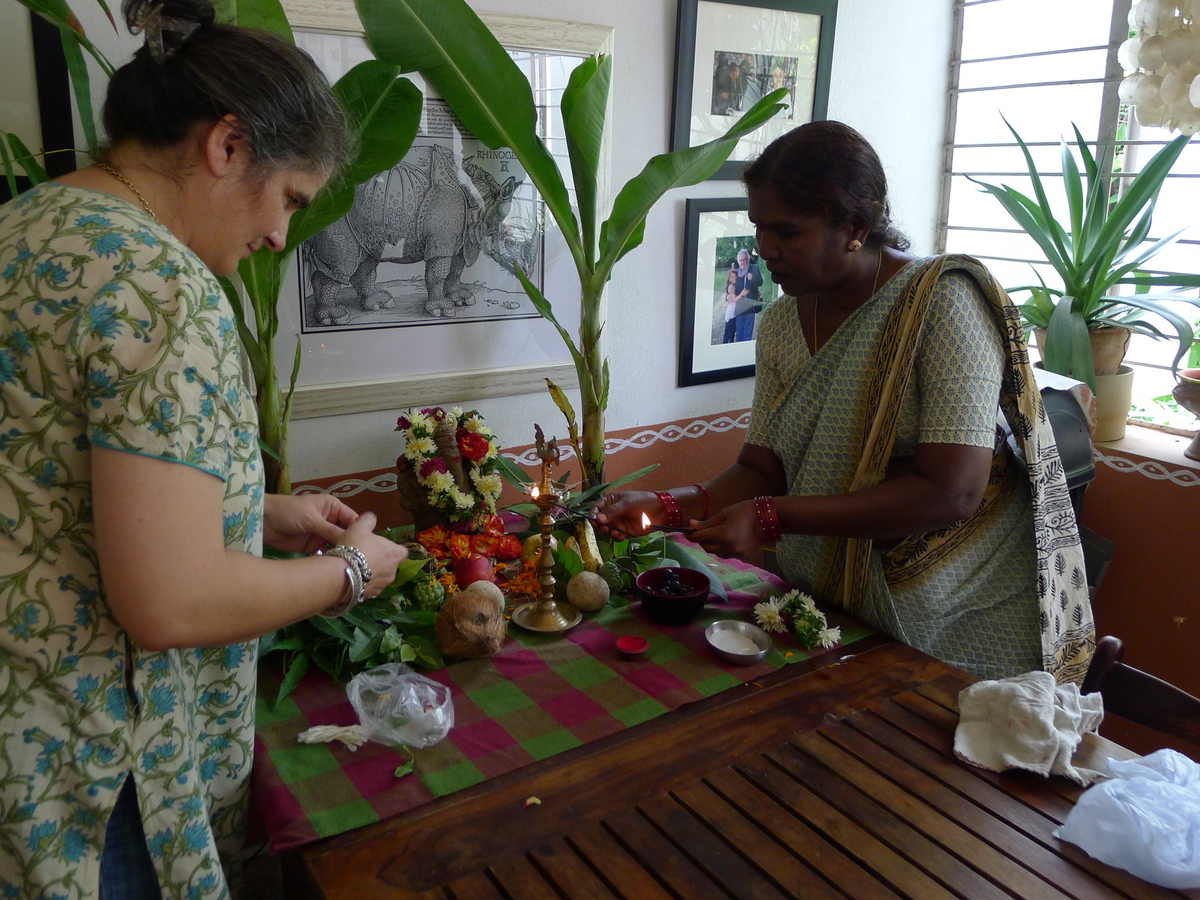
Preparing the table


Lighting the incense


Breaking the coconut


Our Ganesh statue will stay with us for 10 days
 The statue is placed on banana leaves on a table and surrounded by fresh fruit and leaves.  Then one of the ladies who works with us will recite a Hindu prayer, incense is waved over the statue and a coconut is broken in honour of Lord Ganesh.   The two halves are then placed on the table and each of us is marked on the forehead with red vermilion powder.

Happy Ganesh Chaturthi!
 This year we celebrated with a low key Indian lunch but as plans for dinner took shape I was in the mood for something different.   This is where the Italian grandmother’s semolina cake appears!


I have this fabulous baking book called  “Classic Home Desserts: A Treasury of Heirloom and Contemporary Recipes”, written by an American writer and cookbook author Richard Sax.  It’s a compendium of mostly American dessert recipes – though many are influenced by early migrant families from across Europe – and is an engaging mix of recipes, historical and anecdotal notes about cooks and quotes from literary works across 200 years of American and English history.    It was first published in 1994 and won many awards before being republished a few years ago.   (Sadly, Richard Sax died in 1995 from lung cancer at the age of 46.)

One of the standout recipes in the book is called “A Semolina Ring Cake from Friuli”; Friuli is Italy’s most north-eastern region (the Italian filmmaker Pier Paolo Pasolini was born there) and has its own distinctive food culture.   This recipe, which is over 100 years old, found its way into the book via an Italian chef’s grandmother.

My Italian semolina ring cake
I really liked this recipe upon first reading because: (1) it used Italian semolina flour, which I happened to have found surprisingly in an Indian supermarket and (2) it used unpeeled almonds!   You simply put the flour, sugar and unpeeled almonds into a blender and zap at high speed until its a fine powder.  If you have ever peeled 30 or 40 almonds as I have many times, you’ll appreciate this alternative approach!

So this is what we had at the end of dinner last Wednesday night ... an historic Italian semolina cake to celebrate Lord Ganesha’s birthday!

SEMOLINA RING CAKE FROM FRIULI

Ingredients:  
2/3  C blanched or unblanched almonds    ¾ C semolina flour  1 C sugar   grated zest of 1 lemon – 2 in India as they are too small   6 eggs, separated    pinch salt    icing sugar for topping   Plus eggnog custard with rum    (Recipe also says you can serve it with fresh strawberries but they are not in season here.)

Method:     
Preheat oven to 180C degrees .   Butter and flour a cake tin – preferably a round bundt pan.  
Grind the almonds, flour and sugar in a food processor until powdery and then add lemon zest and all of the egg yolks.  Blend and set aside.

The batter after mixing in the beaten eggwhites

Beat the egg yolks and salt in a bowl until they nearly form stiff peaks.   Fold into the semolina- almond mixture and pour into the cake tin.  Bang the tin on a surface several times to settle the batter.
Bake the cake until top is lightly golden ... about 40 minutes worked for me.   Cool cake, run knife around edge of tin, invert onto another plate or cake stand.    Top with the icing sugar & serve with custard or icecream.

Note:   suggest you find a custard recipe you are familiar with and add 1 ½ tablespoons of dark rum.   Me? ... I fucked the custard up completely by overcooking it and making it curdle ... which is why I am not showing you a picture of it ... and is also why my dear departed mother would be utterly ashamed of me!

Nevertheless, the cake was an absolute classic ... beautifully light with a lemony almond aftertaste.   If you can’t make the custard serve it with icecream ... and have a dark rum and soda instead ... that’s what I did.

Tony saab, Hyderabad Sept 2012
   

Tuesday, September 11, 2012

The World's Best Chilli Crab Recipe


Singapore Chilli Crab - in Hyderabad!
 
When I first met my partner we were living in Melbourne and both working in the media there.
She was born and grew up in India – her father was Indian and her mother Australian – so every 12 to 18 months we would plan a trip back to India to visit her father, who at the time was living here in Hyderabad.

 Often we would use this place as a base and go off exploring other parts of India or South Asia for the rest of our holidays.   However, on most of these trips we invariably stopped over in Singapore – either going or coming back – and spent either the day or an overnight stay there.  
 
Singapore - at the crossroads of South Asia
And the main reason for that was the food!   Singapore is blessed with being at the crossroads of trade and migratory movements across South Asia and beyond and as a result it has an extraordinary mix of people and cultures.

From the native Malays, early migrations of Chinese and Indians, and the arrival of the British in the 19th Century - all these cultures have left their mark on Singapore's culinary history.   And situated as it is - in a pivotal area of South Asia - other countries in the region have also heavily influenced the country's cuisine  - from the Philippines, Sri Lanka and neighbouring Indonesia to as far west as the Middle East and Saudia Arabia.

A particularly unique and singular cuisine in Singapore is known as Peranakan or Nonya cuisine.   Perankans are local Singaporese who are the descendents of early Chinese migrants who married local Malays in Singapore itself or in areas such as Penang and Malacca on the Malaysian peninsula.
Nonya cusine is a unique mix of Chinese cooking techniques like wok cooking with the spices used by local Malays and their Indonesian counterparts.   Their curries for example are often coconut based but with lashings of firey spices ... just the way we like it!

All of these different cuisines and much more can be experienced at Singapore's renowned open food markets.   Nowadays they are far more regulated - as everything else seems to be in Singapore! - but despite the somewhat "food mall" atmosphere, the actual cooking and presentation hasn't changed and you can still get extraordiary seafood dishes, satays, curries, savoury pastries , breads of all sorts and endless noodle combinations at these small, often one-owner, businesses.
Orchard Road - the place comes alive after dark ...
We would most often arrive at Singapore's Changhi Airport early in the morning from Melbourne, and then have most of the day to explore some part of the city before our flight to India that same evening.   After a quick bus ride into town we would head for the food stalls at the famous Newton Food Centre and then maybe stroll up the main shopping area along Orchard Road, or the ethnic enclaves of  Chinatown or Little India, or head off to the famous Raffles Hotel for a very atmospheric gin and tonic - or two.  

Raffles Hotel - built in 1887 & extensively renovated 100 years later

The Raffles Hotel - originally built in the 1880s - has also been "renovated" in recent years - they no longer have a  live tiger in a cage in the front bar - but it was still fun to reminisce over a drink on the balcony about the writers and other artists such as Somerset Maugham, Chaplin, Coward, Kipling and Conrad who all stayed in the very same establishment at some point in the early part of the 20th Century.  

Part of the Long Bar, Raffles Hotel
I recently read Maugham's "Collected Stories" and his writing perfectly catches the atmosphere of what these old hotels and other establishments must have been like in the dying days of colonialism in  South Asia.   However, I think you can only read Maugham in small doses as there is often an air of melancholy - sometimes sadness - hanging over his characters ... and living here in 'the tropics' it can be quite infectious ... not to be read with gin, especially!
 

Chilli crab served with rice and crispy cabbage salad
One of our favourite Singapore treats was always the chilli crab - giant mud crabs - bigger than the ones you get in Sydney and further north in Australia - cooked in a chilli and tomato based sauce.   This is the kind of dish you can only eat with your hands, cracking the shells and sucking the meat from the thinner legs as you go.

The best recipe I have used to cook Singapore Chilli Crab comes from Stephanie Alexander's book "The Cooks Companion"; at 1126 pages, this is definitely the bible of Australian cooking and was one of the cookbooks I had to bring with me to India when we moved here again.


The recipe was originally demonstrated to Stephanie by Singapore chef, cookbook writer and restaurateur Violet Oon and she cooked the dish using lobster; however, crabs are much more readily available and cheaper.   Don't be put off by the inclusion of tomato sauce as one of the ingredients; whilst it may look a bit naff' amongst the more Asian ingredients, it blends magically with the chillies, black beans and vinegar.   Besides, tomato sauce - thanks to the Maggi company - is ubiquitous across the whole of Asia these days!

Violet Oon's Chilli Crab

Wash and cut the crabs in half

Ingredients:    1.5 kg crabs in their shells   1/4C vegetable oil    8 cloves of garlic, finely chopped   8 small red chillies, finely chopped (less if you dont like it too spicy)    1 t rice vinegar or lime juice    1 egg, lightly whisked   i bunch coriander - including roots - washed & finely chopped    6 spring onions, cut into short lengths

For the sauce:    1 C water    5 T tomato sauce    1 or 2 teaspoons of Chinese black beans    1 1/2 t cornflour    1/2 t dark soy sauce (shoyu)    3 T sugar    1/2 t salt

Garlic & chilli are first cooked in oil to add fragrance

Method:

Mix all ingredients for the sauce and set aside.    Clean and cut crab into pieces, cutting the carapace in half and separate the larger legs.   (We have a fishmonger to do that for us at the front gate when he delivers!)    Heat a large wok and add oil, add garlic and stirfry 1 minute then add chilli and cook another 1 minute.    Add crab pieces & legs and cook several minutes until the shells begin to go red.  

The crab several minutes after cooking in the rich sauce
Stir sauce ingredients into wok and continue stirring for 2 minutes.   Cover and simmer over high heat for another 7 minutes, by which time all the shells will be dark red.

Remove lid, add rice vinegar and then stir in egg, mixing to form threads in the soupy stock.   Add coriander and spring onion, stir and serve immediately.

There it is ... what we think is the world's best chilli crab recipe!


Tony saab, Hyderabad India, Sept 2012